This training program is designed to prepare the students for Hyperion Essbase Administration. This course teaches you the administrative requirements of Hyperion Essbase. For those charged with maintaining the Essbase environment, this co…
4.8 · Rated by learners Certificate of completion
Duration
25 Hours
Mode
Live + Recorded
Level
Beginner → Pro
Language
English / Hindi
AI practice, included with this course
Rehearse the interview and test yourself before the real thing.
Available in your student dashboard as soon as you enrol —
no extra charge, nothing to install.
Course overview
About the Hyperion Essbase and Planning Administration program.
This training program is designed to prepare the students for Hyperion Essbase Administration. This course teaches you the administrative requirements of Hyperion Essbase. For those charged with maintaining the Essbase environment, this course is essential. The training covers, Configuration Essbase for block storage and aggregate storage applications, Design and Manage Essbase security in native and Shared Services security modes, Optimize Essbase system caches, Execute database backup, restore and recovery, perform application migration and task automation.
Why learn with BISP
Trusted by professionals across 30+ countries.
Industry trainers
Certified consultants with 12+ years of real project experience.
Hands-on practice
Real-time scenarios & live project modules, not just slides.
Placement support
Resume building, mock interviews & job referrals.
Certification
BISP certificate + full guidance for official exams.
Course curriculum
Designed by real-time industry professionals around current job roles.
01A Day as Essbase Administrator Online Analytical Processing Overview6 topics
Data Transformation
Multidimensional View of Information
Dimensional Modeling
Data Cubes
Dimension Hierarchies
OLAP Solutions
02Aggregate Storage Data Structure3 topics
Table space Overview
Data Aggregation
Aggregate Storage Database Statistics
03Essbase Security Overview5 topics
Essbase Native Security
Global Access Security Layer
User and Group Security Layer
Application Access Type Security
The Essbase Security File
04Optimizing Block Storage Caches4 topics
Optimizing the Database
Optimizing Caches
Setting RAM Caches
Cache Hit Ratios
05Managing Fragmentation3 topics
Measuring Database Fragmentation
Preventing and Reducing Database Fragmentation
Removing Security File Fragmentation
06Task Automation5 topics
Automating Tasks Using MaxL
The MaxL Command Shell
MaxL Statements and Syntax
MaxL Username and Password Encryption
Debugging MaxL scripts
07Essbase architecture, components, and production cycle6 topics
Aggregate Storage and Block Storage
Outlines
Load Rules
Calculation Scripts
Aggregations
Reporting in Smart View
08Configuring Essbase Servers in distributed environment4 topics
Setting up runtime and connection options for Essbase
Configuring block storage and aggregate storage disk allocation
Identifying the primary information logs available to Essbase system administrators
Maintaining the Essbase Server configuration file
09Creating Essbase Security Filters4 topics
The Essbase Security Filter Layer
Creating Security Filters
Filter Behavior
Resolving Security Conflicts
10Optimizing Aggregate Storage Cache3 topics
Aggregate Storage Cache Optimization
Managing Aggregate Storage Cache
Viewing Aggregate Storage Cache Statistics
11Managing Applications, Sessions, Usernames, and Passwords3 topics
About Application and Session Management
Migrating Applications and Databases
Enabling/Disabling Usernames in Administration Services Console
12Applying Path in Essbase2 topics
Essbase Multiple Server Environment
An introduction to Perl Script for Essbase Developer
13Block Storage Data Structure4 topics
Data Blocks and the Index System
Block Storage Database Statistics
Data Block Creation
Database Calculation Process
14Essbase Data Integrity3 topics
Ensuring Essbase Data Integrity
Transactions and Locks
Isolation Levels
15Securing the Essbase Environment in Shared Services4 topics
Shared Services Security
Converting Essbase Users to Shared Services Security
Provisioning Users in Shared Services
External Authentication and Single Sign-on
16Optimizing Buffers and Compression3 topics
Setting Data Retrieval Buffers
Data Compression Methods
Setting the Optimal Compression Method
17Backing Up, Restoring, and Recovering Essbase Databases7 topics
About Backup, Restore, and Recovery
Manual Backup and Restore
Automated Backup and Restore
Manual Recovery
Automated Recovery
Recovering from a Server Interruption
Recovering Corrupted Essbase Databases
18Configuring Planning2 topics
Configuring Planning
Installing and Configuring Offline Planning
19Accessing Planning8 topics
Verifying the Installation
Starting Services
Logging on to Workspace
Creating and Deploying Applications
Provisioning Users and Groups
Configuring Smart View
Accessing Planning Applications
Testing Report Connectivity
20Switching Application Modes3 topics
Application Upgrade Wizard
Switching Classic Applications to Performance Management Architect Applications
Switching Performance Management Architect Applications to Classic Applications
21Performing System Maintenance5 topics
Backup and Recovery Overview
Backing Up Databases and File Systems
Backing Up Windows Registry Settings
Backing Up and Recovering EPM System Products
Managing EPM System Log Files
Course details
Who it is for, what you need, and how it is delivered.
Who should learn Hyperion Essbase and Planning Administration?
Essbase Dev
Prerequisites
This certification training course does not presume or require any prior knowledge or prerequisites. However, basic knowledge of salesforce concepts be an added advantageous. We are recommending that students should have following: To be an administrative professional Should possess clear knowledge and grasp of salesforce concepts knowledge on SQL, HTML and JavaScript should be an added advantage
Delivery methodology
We are using an experiential delivering methodology that blends theoretical concepts with hands-on practical learning to ensure a holistic understanding of the subject or course.
Class delivery
Live Interactive classes with expert
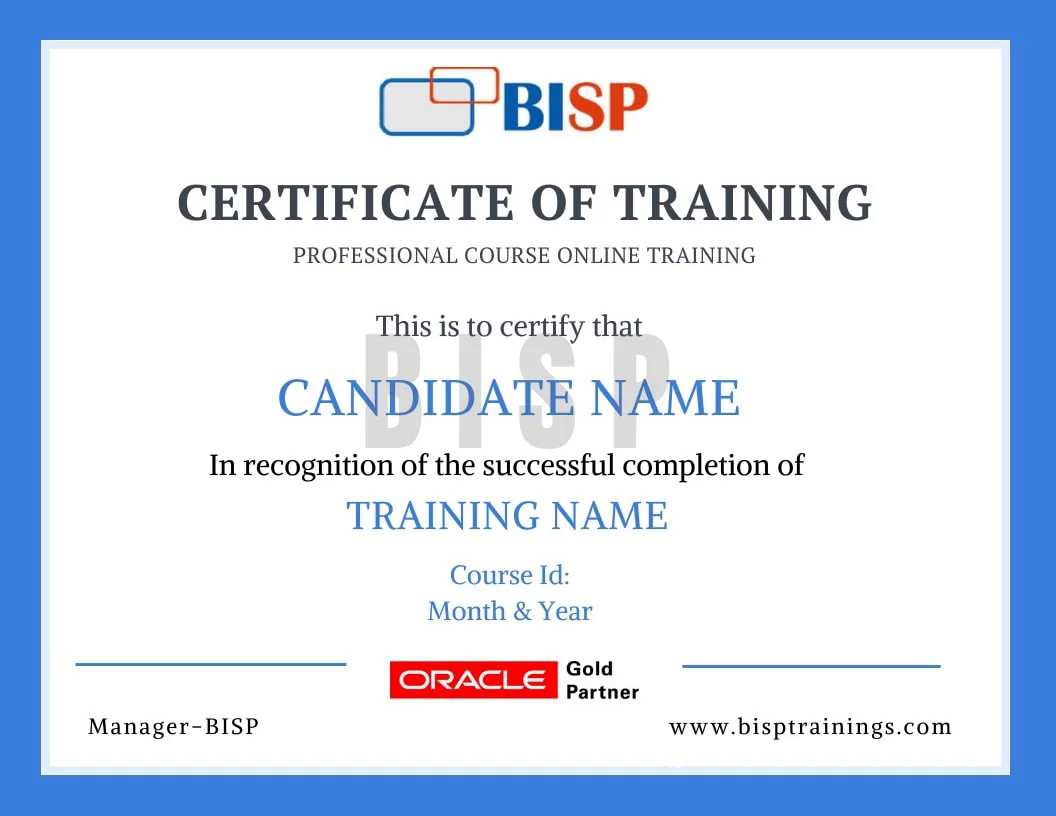
Certificate of completion
Earn an industry-recognised BISP Trainings certificate when you finish the course.
Verifiable certificate with a unique ID
Shareable on LinkedIn & your resume
Recognised by our hiring partners
Frequently asked questions
Everything you need before you enroll.
Can I attend a demo session before enrollment?
Yes. You may attend a demo class before enrollment for training quality evaluation, and interact one-to-one with the trainer for any specific requirement.
Can you schedule training as per my availability?
Yes. We discuss it with the trainer and schedule the training at a convenient time for you.
What if I miss a class?
You get the recorded session. You may also retake the whole training multiple times within a 6-month period with the same trainer.
Is there live project training?
Yes. The curriculum includes real-time scenarios and live project modules, with the trainer explaining every topic end-to-end.
How can I pay for the course?
Enroll securely via the payment gateway on this page using card, UPI or net-banking. EMI options are available.
More queries?
Call us at +91 769-409-5404, or write to support@bisptrainings.com.
 +91 769-409-5404
12.png)