Home Courses Oracle Oracle Data Integration 11g
Oracle

Oracle Data Integration 11g

This training program is designed to prepare the students for Oracle Data Integration Developer track. This training program teaches student how to use Oracle Data Integrator (ODI) to implement high-performance movement and transformation…

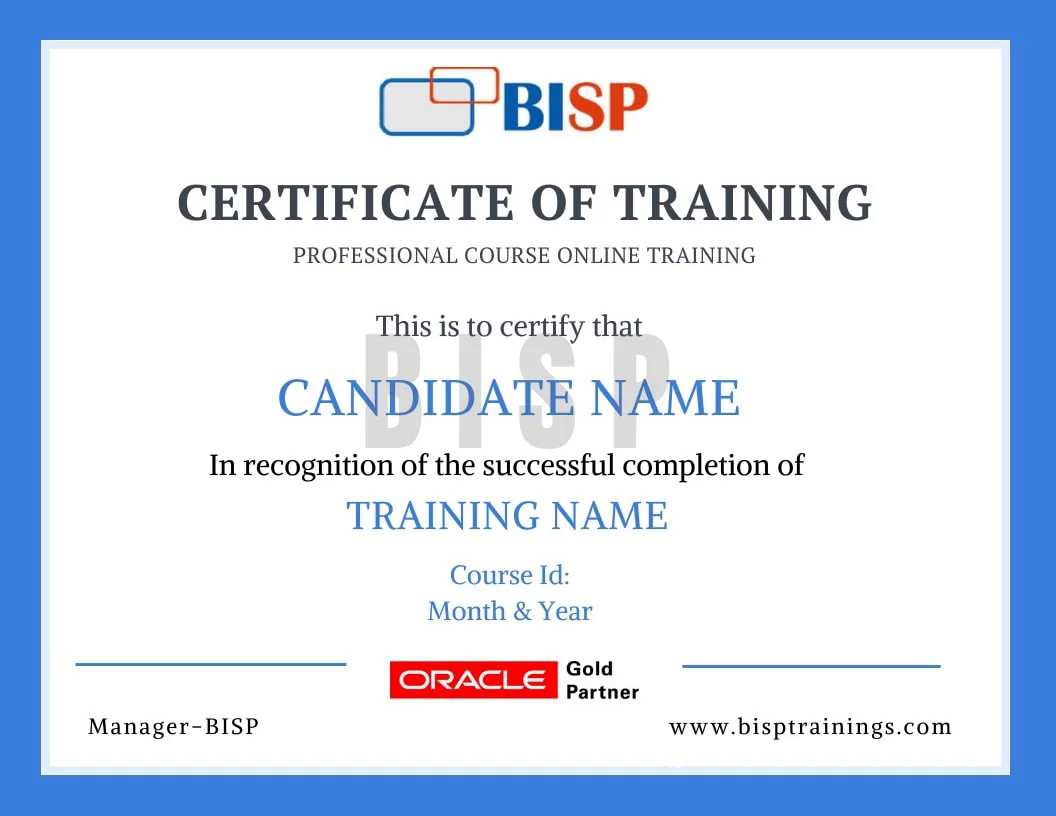
★★★★★ 4.8  ·  Rated by learners 🎓 Certificate of completion
Duration
25 Hours
🎥
Mode
Live + Recorded
📊
Level
Beginner → Pro
🌐
Language
English / Hindi

Course overview

About the Oracle Data Integration 11g program.

This training program is designed to prepare the students for Oracle Data Integration Developer track. This training program teaches student how to use Oracle Data Integrator (ODI) to implement high-performance movement and transformation of data among various platforms. It also deals with usage of ODI graphical user interfaces that enable user to access different ODI components and resources that form ODI infrastructure. Using the graphical interfaces, you create and manage ODI repositories, which store configuration information about the IT infrastructure, the metadata for all applications, projects, models and other ODI artifacts. You also learn how to create the ODI Topology, organize ODI models and design ODI interfaces, procedures, packages and other objects. Describe architecture of Oracle Data Integrator 10g Apply ODI Topology concepts for data integration Describe ODI Model concepts Design ODI Interfaces, Procedures, and Packages to perform ELT data transforma

Why learn with BISP

Trusted by professionals across 30+ countries.

👨‍🏫

Industry trainers

Certified consultants with 12+ years of real project experience.

🧪

Hands-on practice

Real-time scenarios & live project modules, not just slides.

💼

Placement support

Resume building, mock interviews & job referrals.

📜

Certification

BISP certificate + full guidance for official exams.

Course curriculum

Designed by real-time industry professionals around current job roles.

Download curriculum (PDF)

Oracle Data Integration 11G

Introduction

  • Identifying the Course Units
  • What is Oracle Data Integrator?
  • Why Oracle Data Integrator?
  • Overview of ODI 11g Architecture
  • Overview of ODI 11g Components
  • About Graphical Modules
  • Types of ODI Agents
  • Overview of Oracle Data Integrator Repositories

Administering ODI Repositories and Agents

  • Administrating the ODI Repositories
  • Creating Repository Storage Spaces
  • Creating and Connecting to the Master Repository
  • Creating and Connecting to the Work Repository
  • Managing ODI Agents
  • Creating a Physical Agent
  • Launching a Listener, Scheduler and Web Agent
  • Example of Load Balancing

ODI Topology Concepts

  • Overview of ODI Topology
  • About Data Servers and Physical Schemas
  • Defining the Physical Architecture
  • Defining the Logical Architecture
  • Mapping Logical and Physical Resources
  • Defining Agents
  • Defining a Topology
  • Planning the Topology

Describing the Physical and Logical Architecture

  • Overview of Topology Manager
  • Creating Physical Architecture
  • Creating a Data Server
  • Testing a Data Server Connection
  • Creating a Physical Schema
  • Creating Logical Architecture
  • Overview of Logical Architecture and Context Views
  • Linking the Logical and Physical Architecture

Setting Up a New ODI Project

  • Overview of ODI Projects
  • Creating a New Project
  • Using Folders
  • Organizing Projects and Folders
  • Understanding Knowledge Modules
  • Exchanging ODI Objects
  • Exporting and Importing Objects
  • Using Markers

Oracle Data Integrator Model Concepts

  • What is a Model?
  • Understanding Metadata in ODI
  • Understanding Reverse Engineering
  • Creating Models
  • Organizing Models
  • Creating Datastores
  • Using Constraints in ODI
  • Creating Keys and References

Organizing ODI Models and Creating Datastores

  • What is an Interface?
  • Business Rules for Interfaces
  • What is a Mapping?
  • What is a Join?
  • What is a Filter?
  • What is Constraint?
  • What is a Staging Area?
  • Creating a Basic Interface

ODI Interface Concepts

  • What is an Interface?
  • Business Rules for Interfaces
  • What is a Mapping, Filter, Join?
  • Overview of Integration Process
  • What is a Staging Area?
  • About Execution Location
  • Using Knowledge Modules (KM) with ODI Interface
  • Creating a Basic Interface

Designing Interfaces

  • Designing an Interface
  • Multiple Source Datastores
  • Creating Joins
  • Filtering data
  • Disabling Transformations
  • Overview of the Flow
  • Specifying the Staging Area
  • Selecting Knowledge Modules

Interfaces: Monitoring and Debugging

  • Monitoring Interfaces
  • Using Operator
  • Viewing Sessions and Tasks
  • How to Monitor Execution of an Interface
  • How to Troubleshoot a Session
  • Keys to Reviewing the Generated Code
  • Working with Errors
  • Tips for Preventing Errors

Designing Interfaces: Advanced Topics

  • Using Business Rules in Interfaces
  • Overview of Business Rule Elements
  • Using variables
  • Using User Functions
  • Using Substitution Methods
  • Modifying a KM
  • Developing Your Own KM
  • Using RKM for Customized Reverse Engineering

Using ODI procedures

  • What is the Procedure?
  • Examples of Procedures
  • Creating Procedures
  • Adding Commands
  • Adding Options
  • Running a Procedure
  • Using Operator to View Results

Using ODI Packages

  • What is a package?
  • Creating a package
  • Executing a package
  • Creating Advanced Packages
  • Error handling
  • Controlling an Execution Path
  • Creating a Loop
  • Using the Advanced tab

Managing ODI Scenarios and Versions

  • What is the Scenario?
  • Managing Scenarios
  • Preparing Scenarios for Deployment
  • Automating Scenario Management
  • Scheduling the ODI Scenario
  • Overview of ODI version management
  • Using the Version Browser and Version Comparison Tool
  • Handling concurrent changes

Enforcing Data Quality and Auditing Data with ODI

  • Why Data Quality?
  • When to Enforce Data Quality?
  • Data Quality in Source Applications
  • Data Quality Control in the Integration Process
  • Data Quality in the Target Applications
  • Enforcing Data Quality
  • Exploring Your Data
  • Auditing Data Quality

Working with Changed Data Capture

  • Overview of ODI version management
  • Techniques of Changed Data Capture
  • Changed Data Capture in ODI
  • CDC Strategies and Infrastructure
  • CDC Consistency
  • Using CDC
  • Viewing Data/Changed data
  • Using Journalizing

Administering ODI Resources: Advanced Topics

  • Using Open Tools
  • Installing Open Tools
  • Using Open Tools in a Package
  • Using Open Tools in a Procedure or in a KM
  • Developing Your Own Open Tools
  • Setting Up ODI Security
  • Defining Security Policies
  • Defining Password Policies

Case Study 1

Aggregate Example

Case Study 2

Expression Trans & Filter Transformation


Case Study 3

Joiner Transformation & Lookup Transformation

Case Study 4

Rank Transformation & normalize Transformation

Case Study 5

Router Transformation & Seq Generator Trans

Course details

Who it is for, what you need, and how it is delivered.

Who should learn Oracle Data Integration 11g?

DBA, Developer,

Prerequisites

basic knowledge of SQL and relational database

Frequently asked questions

Everything you need before you enroll.

Can I attend a demo session before enrollment?

Yes. You may attend a demo class before enrollment for training quality evaluation, and interact one-to-one with the trainer for any specific requirement.

Can you schedule training as per my availability?

Yes. We discuss it with the trainer and schedule the training at a convenient time for you.

What if I miss a class?

You get the recorded session. You may also retake the whole training multiple times within a 6-month period with the same trainer.

Is there live project training?

Yes. The curriculum includes real-time scenarios and live project modules, with the trainer explaining every topic end-to-end.

How can I pay for the course?

Enroll securely via the payment gateway on this page using card, UPI or net-banking. EMI options are available.

More queries?

Call us at +91 769-409-5404 & +1 678-701-4914, or write to support@bisptrainings.com.

Case studies & learning PDFs

Free Oracle resources to explore.

Relevant courses

Learners who took this also explored these.

Not sure if this course is right for you?

Book a free 1-on-1 counselling call and get a personalised learning roadmap.

Book free trial →