This training program is designed to prepare the students for Oracle SOA Suite Developer. The Oracle SOA Suite11g Implementation training provides relevant insight to current and prospective implementers of SOA. Participants will learn how…
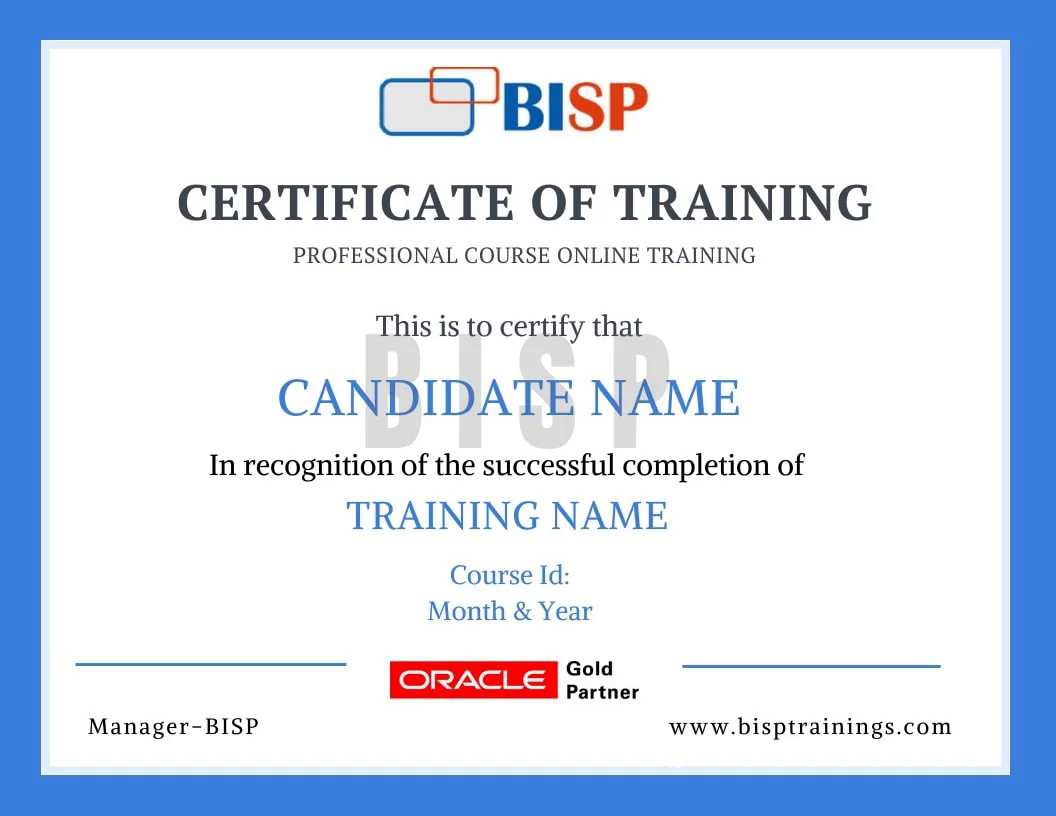
4.8 · Rated by learners Certificate of completion
Duration
30 Hours
Mode
Live + Recorded
Level
Beginner → Pro
Language
English / Hindi
Course overview
About the Oracle 12c Administration program.
This training program is designed to prepare the students for Oracle SOA Suite Developer. The Oracle SOA Suite11g Implementation training provides relevant insight to current and prospective implementers of SOA. Participants will learn how to develop and implement solutions using SOA Suite 11g that will drive their customers organizations to make better decisions, take informed actions, and run more-efficient business processes.
Why learn with BISP
Trusted by professionals across 30+ countries.
Industry trainers
Certified consultants with 12+ years of real project experience.
Hands-on practice
Real-time scenarios & live project modules, not just slides.
Placement support
Resume building, mock interviews & job referrals.
Certification
BISP certificate + full guidance for official exams.
Course curriculum
Designed by real-time industry professionals around current job roles.
Oracle 12c: New Features for DBA
Required Prerequisites:
Oracle Database: Introduction to SQL
Good knowledge of Oracle Database Administrator 11g
Basics of Multitenant Container Database (CDB)
Benefits of the multitenant architecture
Differences between the root container and pluggable database containers
Structure of the root
Structure of Pluggable Database (PDB)
CDB_xxx and DBA_xxx views
Configuring and Creating CDB and PDBs
Tools: DBCA and SQL*Plus
Configuration and creation of CDB
Exploring the Structure (CDB_xxx views and EM)
Tools used: DBCA and SQL*Plus and EM Database Express
Create a new PDB from PDB$SEED
Create a PDB from a non-CDB
Plug in an unplugged PDB
Managing CDB and PDBs
Connect to CDB as administrator
Connect to a PDB using a service name
Start up a CDB
Open / Close a PDB (SQL*Plus)
Open / Close all PDBs
Shut down a CDB
Change PDB state
Managing Tablespaces, Common and Local Users, Privileges and Roles
Create permanent tablespaces in the root and PDBs
Manage common and local schemas and users in the root and PDBs
Manage system and object privileges to common and local grantees granted "commonly" or "locally"
Manage common and local roles granted "commonly" or "locally"
Managing Backup / Recovery / Flashback
Backup a whole CDB
Backup a PDB
Recover CDB from redo log files, control files, undo datafiles loss
Recover PDB from PDB datafiles loss
Flashback at CDB level
Online Datafile Move and Automatic Data Optimization
Customized automated action execution with user-defined function
Customized schedule with DBMS_ILM package
In-Database Archiving
Challenges of old data in tables and 11g solutions
In-database archiving new solutions
Use ROW ARCHIVAL clause to enable row lifecycle state for applications
Set ROW ARCHIVAL VISIBILITY for session level visibility control
Use predicate on ORA_ARCHIVE_STATE column
Temporal Validity versus Temporal History (Transaction Time of FDA)
New clause of CREATE / ALTER TABLE to set a Temporal Validity: PERIOD FOR
New SQL temporal data type
Auditing Enhancements
Review of 11g R2 audit trail implementation
Overview of the Unified Audit Trail
Enabling the Unified Audit Trail
Creating a separate tablespace for the unified audit trail
Granting the AUDIT_ADMIN role to a user for audit trail configuration and management
Configuring the Unified Audit Trail to set a tolerance level for loss of audit records
Creating audit policies
Privileges Enhancements
Implementing Separation of Duty for Database Administration Tasks
Using Database Privilege Analysis
Overview of Database Privilege Analysis
Granting the CAPTURE_ADMIN role to enable management of privilege captures
Creating and starting/stopping privilege captures
Viewing privilege profile data
Querying DBA_PRIV_CAPTURES
Explaining the purpose of the default ORA$DEPENDENCY profile
Oracle Data Redaction
Overview of Oracle Data Redaction
Types of Masking Policies
Administering the EXEMPT REDACTION POLICY system privilege to enable a user to view unmasked values
Managing Masking Policies
Best practices for defining policy expressions
Understanding Masking of Statements Containing Subqueries
Viewing Information About Masking Policies by Querying REDACTION_POLICIES and
REDACTION_COLUMNS
General RMAN New Features and FDA Enhancements
Making Database Connections With RMAN
Using the SYSBACKUP Privilege
Using SQL, DESCRIBE Command, Duplication Operation with the NOOPEN option
Backing up and Restoring Very Large Files
Creating Multisection Backups
Table Level Recovery
Duplication of Database.
ADR and Network Enhancements
ADR file types
New File types
New File locations
New command for ADRCI
Resource Manager and Other Performance Enhancements
Manage resources between PDBs
Manage resources within a PDB
Manage resources with CDB and PDBs plans
Automated maintenance tasks
Current Architecture: Unixmultiprocess / one thread, NT/Windows one process / multithread
New Architecture: Multiprocess / MultiThread
Index and Table Enhancements
Multiple indexes on the same set of columns as long as some characteristic is different
Create table with INVISIBLE columns
Support for invisible columns
Describe online redefinition supports
Describe the Advanced Row Compression
Using the following DDL statements in an online manner
Course details
Who it is for, what you need, and how it is delivered.
Who should learn Oracle 12c Administration?
Fresh Engineering Graduates
Prerequisites
This certification training course does not presume or require any prior knowledge or prerequisites. However, basic knowledge of salesforce concepts be an added advantageous. We are recommending that students should have following: To be an administrative professional Should possess clear knowledge and grasp of salesforce concepts knowledge on SQL, HTML and JavaScript should be an added advantage
Delivery methodology
We are using an experiential delivering methodology that blends theoretical concepts with hands-on practical learning to ensure a holistic understanding of the subject or course.
Class delivery
Live Interactive classes with expert
Certificate of completion
Earn an industry-recognised BISP Trainings certificate when you finish the course.
Verifiable certificate with a unique ID
Shareable on LinkedIn & your resume
Recognised by our hiring partners
Frequently asked questions
Everything you need before you enroll.
Can I attend a demo session before enrollment?
Yes. You may attend a demo class before enrollment for training quality evaluation, and interact one-to-one with the trainer for any specific requirement.
Can you schedule training as per my availability?
Yes. We discuss it with the trainer and schedule the training at a convenient time for you.
What if I miss a class?
You get the recorded session. You may also retake the whole training multiple times within a 6-month period with the same trainer.
Is there live project training?
Yes. The curriculum includes real-time scenarios and live project modules, with the trainer explaining every topic end-to-end.
How can I pay for the course?
Enroll securely via the payment gateway on this page using card, UPI or net-banking. EMI options are available.
More queries?
Call us at +91 769-409-5404 & +1 678-701-4914, or write to support@bisptrainings.com.
 BISP
BISP Call Us: +91 769-409-5404