Live online batches across IST, EST & GST — learners in 189+ countries
Home Courses Others Developing Applications for the Java EE 6 Platform
Others

Developing Applications for the Java EE 6 Platform

The Developing Applications for the Java(TM) EE Platform training helps you develop the knowledge to build and deploy enterprise applications that comply with Java(TM) Platform, Enterprise Edition 6 technology standards. This course is ide…

4.8  ·  Rated by learners Certificate of completion
Duration
25 Hours
Mode
Live + Recorded
Level
Beginner → Pro
Language
English / Hindi

Course overview

About the Developing Applications for the Java EE 6 Platform program.

The Developing Applications for the Java(TM) EE Platform training helps you develop the knowledge to build and deploy enterprise applications that comply with Java(TM) Platform, Enterprise Edition 6 technology standards. This course is ideal for Sun(TM) Certified Java technology programmers who want to develop enterprise applications that conform to the Java EE platform standards.

Why learn with BISP

Trusted by professionals across 30+ countries.

Industry trainers

Certified consultants with 12+ years of real project experience.

Hands-on practice

Real-time scenarios & live project modules, not just slides.

Placement support

Resume building, mock interviews & job referrals.

Certification

BISP certificate + full guidance for official exams.

Course curriculum

Designed by real-time industry professionals around current job roles.

Download curriculum (PDF)

Developing Applications for the java EE 6 Platform online Training Course Curriculum


An Introduction to Java EE Technologies

  • Describe the different Java platforms and versions
  • Describe the needs of enterprise applications
  • Introduce the Java EE APIs and services
  • Certifications Paths
  • Introducing Applications Servers
  • Enterprise Modules

Developing Servlets

  • Describe the servlet API
  • Servlet configuration through annotations and deployment descriptors
  • Use the request and response APIs
  • Servlets as controllers

EJB Overview

  • EJB types: Session Beans
  • EJB types:Message Driven beans
  • Java Persistence API as a replacement for Entity EJBs
  • Describe the role of EJBs in a Java EE application
  • EJB lite

Implementing a Transaction Policy

  • Describe transaction semantics
  • Compare programmatic and declarative transaction scoping
  • Use the Java Transaction API (JTA) to scope transactions programmatically
  • Implement a container-managed transaction policy
  • Support optimistic locking with the versioning of entity components
  • Support pessimistic locking of entity components
  • Using transactions with the web profile

Web Service Model

  • Describe the role of web services
  • Web service models
  • List the specifications used to make web services platform independent
  • Describe the Java APIs used for XML processing and web services

Enterprise Application Architecture

  • Design Patterns
  • Model View Controller
  • Synchronous and Asynchronous communication
  • Network Topologies and Clustering
  • Layering (client, presentation, service, integration, persistence)

Developing With JavaServer Pages Technology

  • Evaluate the role of JSP technology as a presentation mechanism
  • Author JSP pages
  • Process data received from servlets in a JSP page
  • Brief introduction to the JSTL and EL

Implementing EJB 3.0 Session Beans

  • Compare stateless and stateful behavior
  • Describe the operational characteristics of a stateless session bean
  • Describe the operational characteristics of a stateful session bean
  • Describe the operational characteristics of a singleton session bean
  • Create session beans
  • Package and deploy session beans
  • Create session bean clients

Developing Asynchronous Java EE Applications and Messaging

  • The need for asynchronous execution
  • JMS technology introduction
  • List the capabilities and limitations of Java EE components as messaging producers and consumers
  • JMS and transactions
  • JMS administration

Implementing Java EE Web Services with JAX-WS and JAX-RS

  • Describe endpoints supported by the Java EE 6 platform
  • Developing Web Services with Java
  • Creating Web Service Clients with Java

Web Technology Overview

  • Describe the role of web components in a Java EE application
  • Define the HTTP request-response model
  • Compare Java servlets, JSP, and JSF
  • Brief introduction to technologies not covered in detail

JavaServer Faces

  • The JSF model explained
  • Adding JSF support to web applications
  • Using the JSF tag libraries
  • Configuring JSF page navigation
  • JSF Managed beans
  • JSF Conversion, Validation, and Error Handling

The Java Persistence API

  • The role of the Java Persistence API in a Java EE application
  • Object Relational Mapping
  • Entity class creation
  • Using the EntityManager API
  • The life cycle and operational characteristics of Entity components
  • Persistent Units and Packaging

Developing Message-Driven Beans

  • Describe the properties and life cycle of message-driven beans
  • Create a JMS message-driven bean

Implementing a Security Policy

  • Exploit container-managed security
  • Define user roles and responsibilities
  • Create a role-based security policy
  • Use the security API
  • Configure authentication in the web tier

Delivery Methodology

  • We are using an experiential delivering methodology that blends theoretical concepts with hands-on practical learning to ensure a holistic understanding of the subject or course

Class Delivery

  • Live Interactive classes with expert

Course details

Who it is for, what you need, and how it is delivered.

Who should learn Developing Applications for the Java EE 6 Platform?

Developers

Prerequisites

Sound knowledge of Java Programing

Knowledge of object serialization

Knowledge of RDBMS theory and SQL

Familiarity with the use of an IDE

Delivery methodology

We are using an experiential delivering methodology that blends theoretical concepts with hands-on practical learning to ensure a holistic understanding of the subject or course.

Class delivery

Live Interactive classes with expert

Certificate of completion

Earn an industry-recognised BISP Trainings certificate when you finish the course.
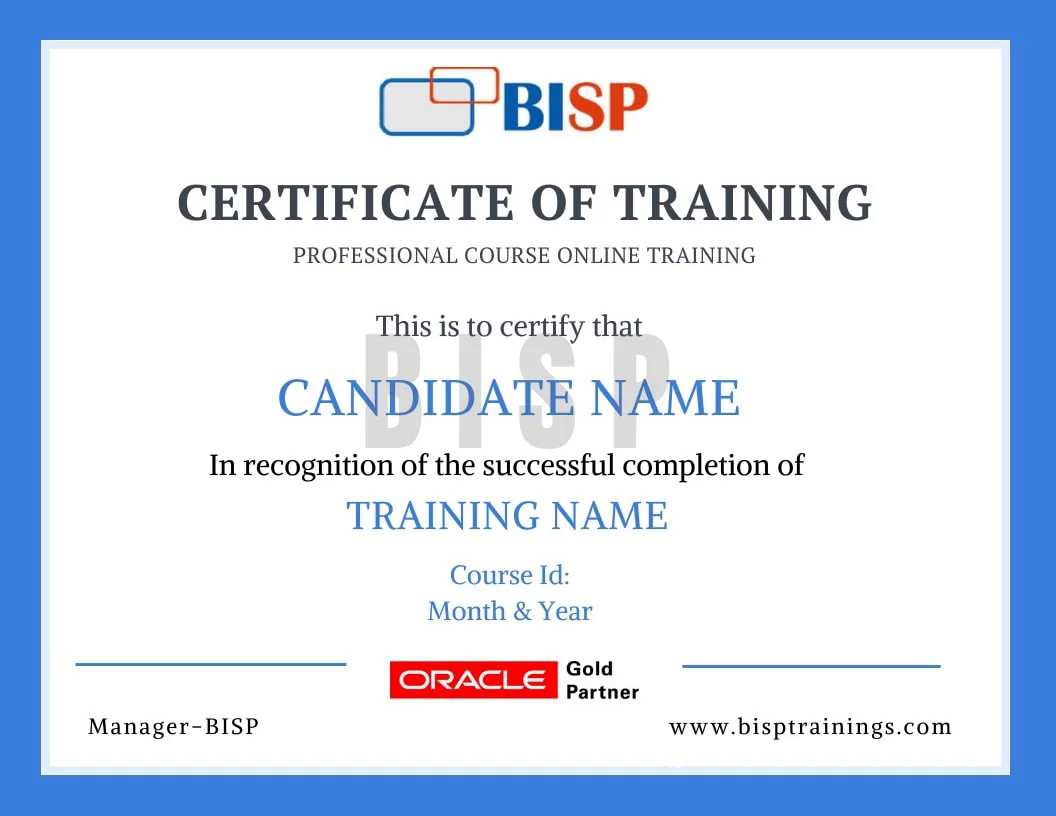
BISP Trainings Certificate of Completion
  • Verifiable certificate with a unique ID
  • Shareable on LinkedIn & your resume
  • Recognised by our hiring partners

Frequently asked questions

Everything you need before you enroll.

Can I attend a demo session before enrollment?

Yes. You may attend a demo class before enrollment for training quality evaluation, and interact one-to-one with the trainer for any specific requirement.

Can you schedule training as per my availability?

Yes. We discuss it with the trainer and schedule the training at a convenient time for you.

What if I miss a class?

You get the recorded session. You may also retake the whole training multiple times within a 6-month period with the same trainer.

Is there live project training?

Yes. The curriculum includes real-time scenarios and live project modules, with the trainer explaining every topic end-to-end.

How can I pay for the course?

Enroll securely via the payment gateway on this page using card, UPI or net-banking. EMI options are available.

More queries?

Call us at +91 769-409-5404 & +1 678-701-4914, or write to support@bisptrainings.com.

Case studies & learning PDFs

Free Others resources to explore.

Relevant courses

Learners who took this also explored these.

Not sure if this course is right for you?

Book a free 1-on-1 counselling call and get a personalised learning roadmap.

Book free trial →