Live online batches across IST, EST & GST — learners in 189+ countries
Home Courses Oracle MySQL
Oracle Upskill with BISP Powered By AI

MySQL

MySQL is an open-source database management system that is being used to manage database systems, retrieving data from database tables, etc. ... SQL is a type of programming language which is used for manipulating data in the database.

4.8  ·  Rated by learners Certificate of completion
Duration
25 Hours
Mode
Live + Recorded
Level
Beginner → Pro
Language
English / Hindi

Course overview

About the MySQL program.

MySQL is an open-source database management system that is being used to manage database systems, retrieving data from database tables, etc. ... SQL is a type of programming language which is used for manipulating data in the database.

Why learn with BISP

Trusted by professionals across 30+ countries.

Industry trainers

Certified consultants with 12+ years of real project experience.

Hands-on practice

Real-time scenarios & live project modules, not just slides.

Placement support

Resume building, mock interviews & job referrals.

Certification

BISP certificate + full guidance for official exams.

Course curriculum

Designed by real-time industry professionals around current job roles.

Download curriculum (PDF)
9 modules 55 topics
01 Relational Database Basics 4 topics
  • Brief History of SQL
  • Relational Databases Tables Rows Columns Relationships Datatypes Primary Keys Foreign Keys Relational Database Management System
  • Popular Databases Commercial Databases Popular Open Source Databases Valid Object References
  • SQL Statements Database Manipulation Language (DML) Database Definition Language (DDL) Database Control Language (DCL)
02 Simple SELECTs 17 topics
  • Introduction to the Northwind Database
  • Some Basics Comments Whitespace and Semi-colons Case Sensitivity
  • SELECTing All Columns in All Rows
  • Exploring the Tables
  • SELECTing Specific Columns
  • SELECTing Specific Columns
  • Sorting Records Sorting By a Single Column Sorting By Multiple Columns Sorting By Column Position Ascending and Descending Sorts
  • Sorting Results
  • The WHERE Clause and Operator Symbols Checking for Equality Checking for Inequality Checking for Greater or Less Than Checking for NULL WHERE and ORDER BY
  • Using the WHERE clause to check for equality or inequality
  • Using the WHERE clause to check for greater or less than
  • Checking for NULL
  • Using WHERE and ORDER BY Together
  • The WHERE Clause and Operator Words The BETWEEN Operator The IN Operator The LIKE Operator The NOT Operator
  • More SELECTs with WHERE
  • Checking Multiple Conditions AND OR Order of Evaluation
  • Writing SELECTs with Multiple Conditions
03 Advanced SELECTs 6 topics
  • Calculated Fields Concatenation Mathematical Calculations Aliases
  • Calculating Fields
  • Aggregate Functions and Grouping Aggregate Functions Grouping Data Selecting Distinct Records
  • Working with Aggregate Functions
  • Built-in Data Manipulation Functions Common Math Functions Common String Functions Common Date Functions
  • Data Manipulation Functions
04 Subqueries, Joins and Unions 7 topics
  • Subqueries
  • Subqueries
  • Joins Table Aliases Multi-table Joins
  • Using Joins
  • Outer Joins
  • Unions UNION ALL UNION Rules
  • Working with Unions
05 Conditional Processing with CASE 2 topics
  • Using CASE
  • Working with CASE
06 Inserting, Updating and Deleting Records 5 topics
  • INSERT
  • Inserting Records
  • UPDATE
  • DELETE
  • Updating and Deleting Records
07 Creating and Modifying Tables 6 topics
  • Data Types
  • Creating Tables NULL Values Primary Keys Foreign Keys
  • Creating Tables
  • Adding and Dropping Columns
  • Renaming Tables SQL Server Oracle and MySQL
  • Dropping Tables
08 Views 4 topics
  • Creating Views InnoDB
  • Dropping Views
  • Benefits of Views
  • Creating a View
09 Stored Procedures 4 topics
  • Creating Stored Procedures
  • Dropping Stored Procedures
  • Creating a Stored Procedure
  • Benefits of Stored Procedures

Certificate of completion

Earn an industry-recognised BISP Trainings certificate when you finish the course.
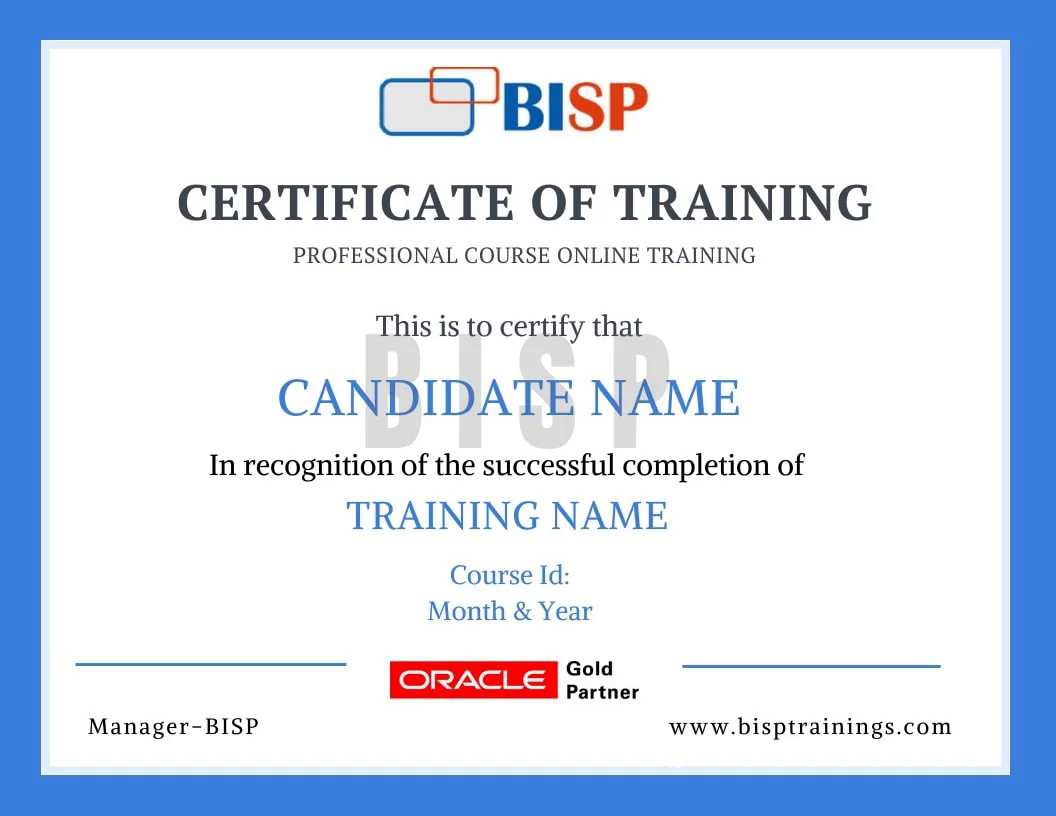
BISP Trainings Certificate of Completion
  • Verifiable certificate with a unique ID
  • Shareable on LinkedIn & your resume
  • Recognised by our hiring partners

Upcoming batches

Reserve your seat for the next live session.

SessionDateTimeReserve
D 01 Jan 2027 (Fri) 08:00 Reserve seat →
R 04 Jan 2027 (Mon) 08:00 Reserve seat →

Frequently asked questions

Everything you need before you enroll.

Can I attend a demo session before enrollment?

Yes. You may attend a demo class before enrollment for training quality evaluation, and interact one-to-one with the trainer for any specific requirement.

Can you schedule training as per my availability?

Yes. We discuss it with the trainer and schedule the training at a convenient time for you.

What if I miss a class?

You get the recorded session. You may also retake the whole training multiple times within a 6-month period with the same trainer.

Is there live project training?

Yes. The curriculum includes real-time scenarios and live project modules, with the trainer explaining every topic end-to-end.

How can I pay for the course?

Enroll securely via the payment gateway on this page using card, UPI or net-banking. EMI options are available.

More queries?

Call us at +91 769-409-5404 & +1 678-701-4914, or write to support@bisptrainings.com.

Case studies & learning PDFs

Free Oracle resources to explore.

Not sure if this course is right for you?

Book a free 1-on-1 counselling call and get a personalised learning roadmap.

Book free trial →